Most Colorado homeowners pay between $400 and $2,000 to remove a tree, with typical Front Range jobs landing in the $700–$1,300 range. Small ornamentals can come down for a few hundred dollars, while a giant cottonwood leaning over a house — or a crane job on a steep mountain lot — can run $3,000–$6,000 or more.
Alpenglow Tree Care is a licensed and insured tree service based in Broomfield, Colorado, serving Denver, the Northern Metro, the Front Range foothills, and the High Country including Summit County and Breckenridge. We quote hundreds of removals a year, and this guide reflects how those jobs actually get priced in 2026 — by size, access, condition, and risk — so you can read a bid and know whether it's fair.
How Much Does Tree Removal Cost by Tree Size?
Alpenglow Tree Care prices removals primarily on height and trunk diameter, because size determines crew hours, equipment, and how much wood has to leave your property. Typical Front Range ranges look like this:
- Small trees (under 25 ft) — most homeowners pay $300–$700. Think crabapples, junipers, and young aspens.
- Medium trees (25–50 ft) — most jobs run $600–$1,300. Mature honeylocusts, ash, and mid-size spruce fall here.
- Large trees (50–75 ft) — expect $1,200–$2,800. Mature silver maples, Siberian elms, and big blue spruce.
- Very large trees (75 ft+) — $2,500–$6,000 or more. The plains cottonwoods that dominate older Denver and Broomfield neighborhoods routinely land at the top of this range.
Those ranges assume a scheduled removal with reasonable access. A 40-foot tree in an open front yard is a straightforward day; the same tree wedged between your house and a fence is a rigging job, and the price reflects it. If you're not sure the tree actually needs to come down, start with our guide to the signs a tree needs removal — pruning or cabling saves the tree and the money when the structure is still sound.
What Makes a Tree More Expensive to Remove?
Alpenglow Tree Care sees the same handful of factors move a bid up or down on nearly every job. Two trees of identical size can differ in price by two or three times because of them:
- Access — If a chip truck and equipment can reach the tree, the job goes fast. Backyard trees behind narrow gates mean hand-carrying brush and wood, which adds crew hours.
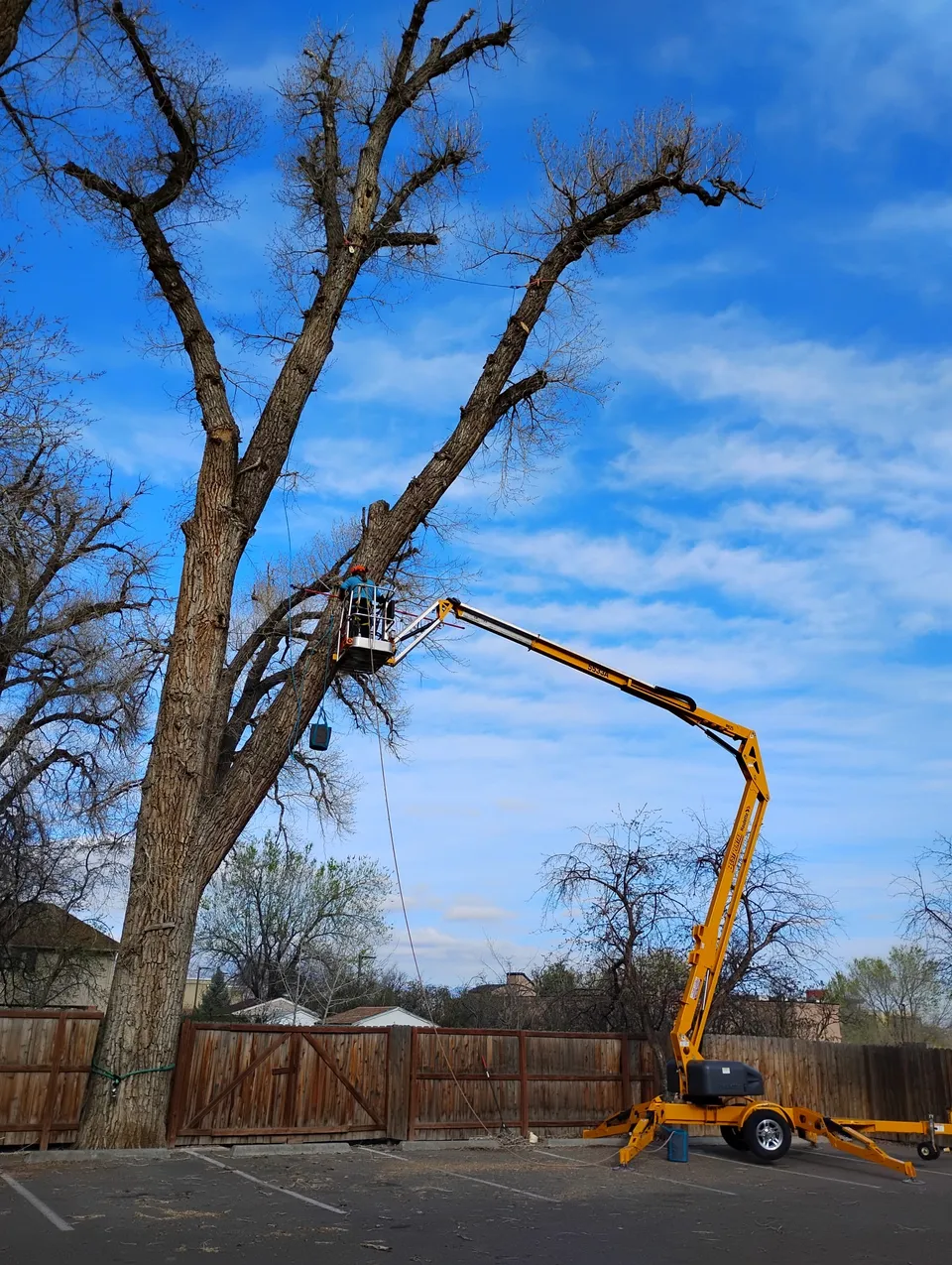
- Proximity to structures — A tree overhanging a roof, deck, or power service line can't simply be felled. Climbers dismantle it piece by piece, roping each section down. Technical rigging is the single biggest price multiplier in the metro.
- Condition — Dead and dying trees are more expensive, not less. Dead wood is brittle and unpredictable, so climbers can't trust it to hold their weight or an anchor point. Severely decayed trees often require a lift or crane for safety.
- Slope and terrain — On foothills and mountain properties, steep ground slows every stage of the work and limits where equipment can sit. Removals in Coal Creek Canyon or above Boulder price differently than the same tree in Westminster.
- Crane work — When a tree is too hazardous to climb or too tight to rig, a crane lifts sections out over the house. Crane involvement commonly adds $1,000–$2,500 to a removal, and large single-day crane jobs can exceed that.
How Much More Does Emergency Tree Removal Cost?
Alpenglow Tree Care typically sees emergency and storm-damage removals run 1.5–3 times normal rates. A removal that would cost $1,500 on the schedule can reach $2,500–$4,500 when a crew mobilizes at night, in weather, to get a tree off a structure safely. The premium pays for immediate response, hazardous working conditions, and often crane time.
Colorado earns that premium honestly: spring snowstorms with heavy, wet snow snap fully leafed branches every year, and summer downbursts along the Front Range take down whole cottonwoods. After a major storm, demand spikes and every insured crew's schedule fills within hours — another reason storm work costs more. If a tree is already on your roof, read our step-by-step guide on what to do when a tree falls on your house, then call us. Our storm cleanup crew handles emergency response across the Denver metro and the foothills.
One cost-saving note: insurance usually covers removal when a tree hits a covered structure. Document the damage with photos before anything is moved, and get the tree service's itemized invoice for your adjuster.
Is Stump Grinding Included in Tree Removal Cost?
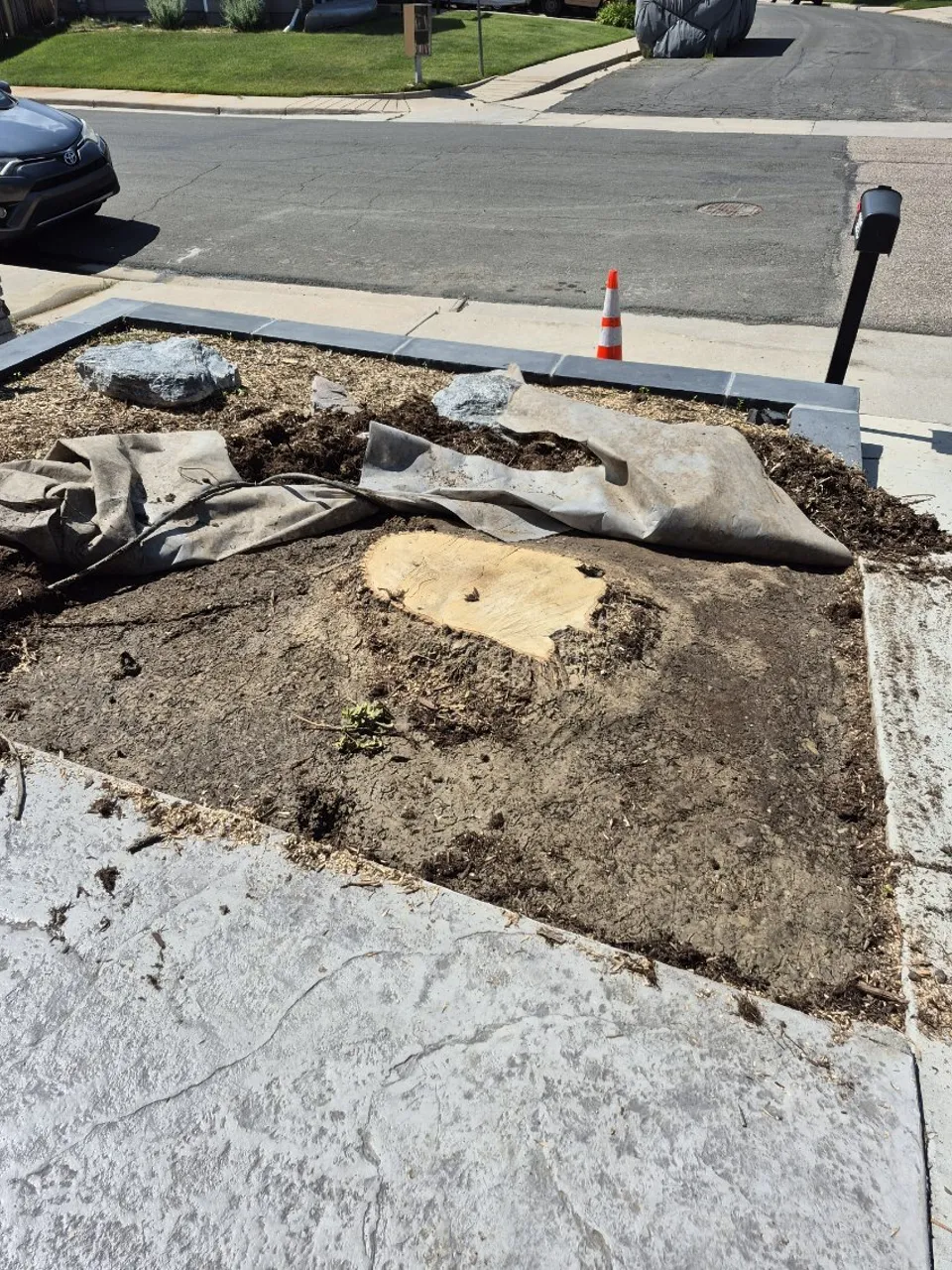
Alpenglow Tree Care quotes stump grinding as a separate line item, and so do most Colorado tree services — a standard removal cuts the tree to a low stump and stops there. Grinding that stump 6–12 inches below grade typically costs $100–$400 depending on diameter, access, and how much surface root flare comes with it.
Whether it's worth it depends on your plans. If you want to replant, sod over the spot, or stop cottonwood and aspen suckers from resprouting, grind it. If the stump sits in a back corner of a large lot, plenty of homeowners skip it. We break down diameter pricing, root chasing, and haul-away in our full stump grinding cost guide, and you can see how the service works on our stump grinding page.
What's Included in a Tree Removal Quote?
Alpenglow Tree Care writes itemized quotes so you know exactly what you're paying for, and any reputable company should do the same. A complete removal quote covers:
- Felling or dismantling the tree, including all rigging and climbing work
- Chipping the brush and hauling chips away (or leaving them as free mulch if you want them)
- Bucking the trunk into movable rounds and hauling the wood off site
- Raking and cleanup of the work area — the yard should look better than we found it, minus one tree
Common exclusions to ask about: stump grinding (see above), hauling the trunk wood versus leaving rounds for firewood (leaving wood on site usually saves money), and splitting firewood, which is almost never included. If a bid is one number on a text message with none of this spelled out, keep shopping.
When Is a Cheap Tree Removal Bid a Red Flag?
Alpenglow Tree Care loses a few jobs every month to bids that are 40–50% lower than everyone else's — and the reason those bids can be that low is almost always insurance. Tree work is one of the most dangerous trades in the country, and legitimate companies carry both general liability insurance and workers' compensation. Those policies are a real cost built into every honest quote.
Here's what that means for you: if an uninsured worker is injured on your property, or your roof is damaged by a botched drop, you — the homeowner — can be on the hook. Before hiring anyone, ask for a certificate of insurance sent directly from the insurer, naming both liability and workers' comp. A company that hesitates has answered your question. Be especially wary of door-knockers working neighborhoods after storms with a truck, a chainsaw, and a cash price.
A fair bid also reflects a real assessment. When we quote a tree removal, we look at lean, decay, targets, access, and utility clearance before pricing — not just tree height. A number quoted from the truck window without walking the property isn't a quote, it's a guess you'll pay for later.
Why Does Tree Removal Cost More in the High Country?
Alpenglow Tree Care serves Summit County, Breckenridge, and surrounding mountain communities, and High Country removals generally run 25–50% above an equivalent metro job. Several factors stack up:
- Travel and mobilization — Crew and equipment time over the passes gets built into the price.
- Terrain — Steep, rocky lots limit equipment access, so more of the tree comes down by rope and hand.
- Beetle-kill lodgepole — Standing dead pine is brittle, unpredictable, and often clustered in groups, which makes mountain removals slower and riskier per tree. On the plus side, multi-tree defensible-space projects usually price better per tree than one-offs.
- Disposal distance — Slash and log disposal sites are fewer and farther between than in the metro.
- Season — The mountain work window is shorter, and some HOAs and counties restrict cutting dates, which concentrates demand.
If you own in Summit County, wildfire mitigation is the other half of this conversation — removing beetle-kill and thinning dense lodgepole around a home is often the highest-value tree work a mountain property owner can buy.
Common Questions About Tree Removal Cost in Colorado
How much does it cost to remove a large tree in Denver?
A large tree (50-75 feet) in the Denver metro typically costs $1,200-$2,800 to remove, depending on access and how close it stands to structures. Very large cottonwoods over 75 feet, or removals that require a crane, commonly run $2,500-$6,000 or more. Get an itemized written quote — reputable companies price the specific tree, not a flat rate.
Does homeowners insurance cover tree removal in Colorado?
Usually only when the tree falls on a covered structure — a house, garage, fence, or driveway — during a storm. Insurance rarely pays to remove a standing tree, even a dead one. And if a dead tree you ignored later damages a neighbor's property, you can be held liable, which is one reason proactive removal is cheaper than waiting.
Why does emergency tree removal cost more?
Emergency removals typically run 1.5-3 times normal rates because crews mobilize outside scheduled hours, work around damaged structures and downed lines, and often need cranes to lift trees off roofs safely. After major Front Range storms, demand also spikes — dozens of homeowners call the same handful of insured crews at once.
Is stump grinding included in the cost of tree removal?
Usually not — most Colorado tree services quote stump grinding as a separate line item, typically $100-$400 per stump depending on diameter and access. Always ask whether the bid includes the stump, surface roots, and haul-away of grindings so you can compare quotes accurately.
Last Updated: August 2026